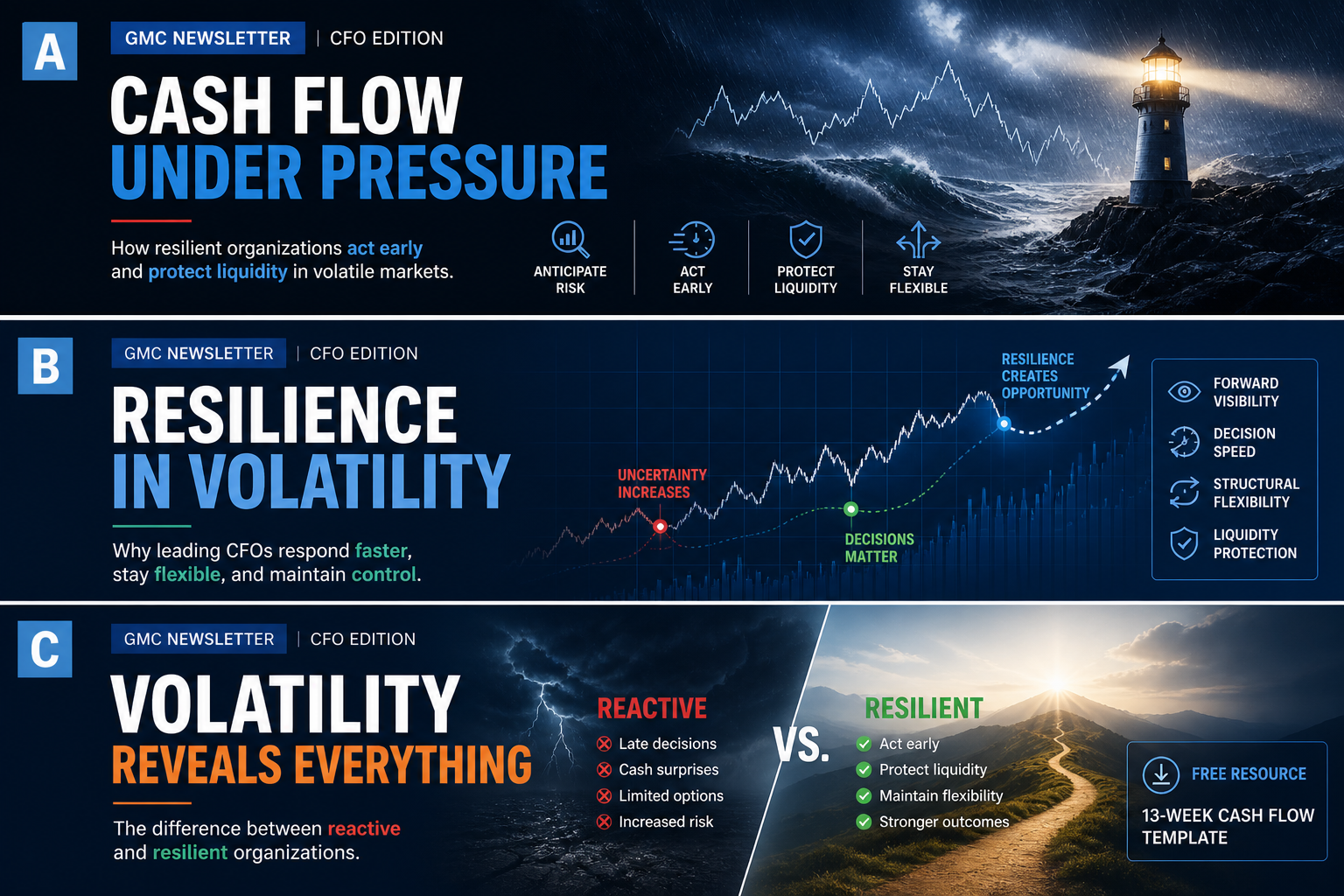
Market conditions have shifted. Demand is less predictable, payment cycles are less reliable, and cost structures are more volatile. Cash flow is no longer just managed—it must be continuously protected and re-engineered.
The new reality: volatility is the baseline
For CFOs, today’s environment creates a different kind of challenge. Cash flow can no longer be treated as a periodic reporting exercise; it requires continuous attention, protection, and redesign.
- Demand is less predictable
- Payment cycles are less reliable
- Cost structures are more volatile
Cash flow is no longer just managed—it must be continuously protected and re-engineered.
What volatility exposes
In stable environments, inefficiencies are often hidden. In volatile markets, they surface quickly. Liquidity preservation remains one of the top priorities for finance leaders during uncertainty.
- Delayed receivables compound faster
- Fixed costs become more restrictive
- Liquidity buffers erode under pressure
The key difference: reactive versus resilient organizations
Reactive organizations rely on historical reporting, respond after liquidity pressure appears, delay decisions because of uncertainty, and treat cash flow as a finance responsibility. The result is late action, constrained choices, and increased risk.
Resilient organizations operate with forward visibility, act before pressure materializes, use predefined decision triggers, and treat cash flow as a cross-functional discipline. The result is greater control, flexibility, and a faster response.
1. Forward visibility—not just reporting
Resilient organizations do not rely on monthly reports. They maintain a current view of liquidity and use it to identify pressure while there is still time to respond.
- Weekly updated forecasts
- Scenario planning across base, downside, and stress cases
- Real-time awareness of the liquidity position
2. Decision speed under uncertainty
In volatile environments, delay is risk. Resilient CFOs ensure decisions are triggered early, trade-offs are clear, and actions are defined before pressure narrows the available choices.
The goal is not perfect information. It is timely action.
3. Structural flexibility
Organizations with rigid cost structures struggle when conditions change. Resilient organizations deliberately create room to adjust without destabilizing the entire operation.
- Variable cost components
- Phased investment approaches
- Flexible supplier and customer terms
Case insight: same market, different outcome
Company A identifies cash pressure only after it occurs, cuts costs abruptly, and delays decisions under uncertainty.
Company B identifies the risk six to eight weeks in advance, adjusts the timing of initiatives, and protects liquidity without disrupting operations.
Same environment. Different outcomes—driven by preparedness and discipline.
What this means for CFOs
Cash flow management in volatility is not about prediction. It is about preparedness and optionality. That requires continuous visibility, clear decision frameworks, and alignment across functions.
The strategic shift is from managing cash flow to designing resilience into the system. Volatility does not create risk. It reveals it. The organizations that respond differently are not lucky—they are prepared.
A question for finance leaders
How does your organization handle cash flow in uncertain conditions: reactively, proactively, or as a discipline fully integrated into decision-making?
References
Deloitte (2023–2025), CFO Signals Survey.
McKinsey & Company (2022–2024), working-capital and cash-flow insights.